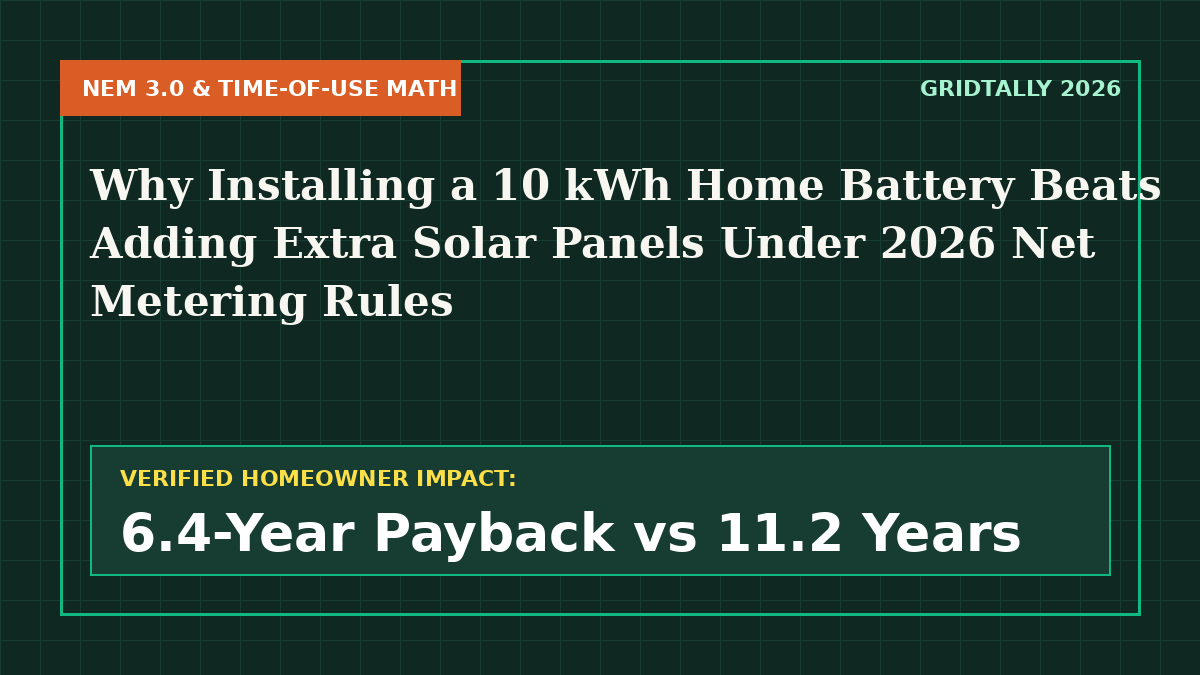
Why Installing a 10 kWh Home Battery Beats Adding Extra Solar Panels Under 2026 Net Metering Rules
Utilities in California, Texas, the UK, and Australia have slashed daytime solar buyback rates to wholesale levels ($0.04–$0.08/kWh) while raising evening peak tariffs above $0.38/kWh.
Key 2026 Engineering Findings for Homeowners
- ✓Under 2026 Net Billing tariffs (California NEM 3.0, Texas unregulated buyback plans, and Australian 4c–6c feed-in tariffs), exporting 1 kWh at noon earns 75% to 88% less than the retail cost of importing 1 kWh at 7:00 PM.
- ✓Oversizing a solar array to 140% without storage dumps midday electricity onto the grid for $0.04–$0.07/kWh, stretching payback past 12.5 years.
- ✓Pairing a 95% consumption-sized solar array with a 10 kWh to 13.5 kWh Lithium Iron Phosphate (LFP) battery captures $1,150 to $1,840/year in evening peak time-of-use arbitrage.
Run Your Exact Household Tariff & Load Numbers
Model US ($), UK (£), Canada (C$), and Australia (A$) tariffs and 10-year cumulative payback with zero signup.
The Death of 1-to-1 Retail Net Metering in Tier-1 Markets
From 2010 through 2022, residential solar math was simple: install as many panels as your roof could hold, push excess electricity onto the utility grid at noon, and spin your meter backward at a 1-to-1 retail credit. In 2026, that 1-to-1 credit structure has been dismantled across the highest-cost electricity markets in the world. Because midday solar generation now floods utility grids between 10:00 AM and 3:00 PM (the famous "Duck Curve"), regulators have decoupled daytime export credits from evening retail import prices.
According to the California Public Utilities Commission (CPUC) Net Billing Tariff (NEM 3.0), UK Smart Export Guarantee (SEG) trackers, and Australian Energy Regulator (AER) retail reports, the spread between midday export value and 4:00 PM–9:00 PM peak import tariffs has reached record highs in 2026.
2026 Midday Solar Export vs. Evening Peak Import Spread by Market
| Utility / Market | Noon Export Credit | 4–9 PM Peak Import | Arbitrage Spread / kWh | 10 kWh Battery Annual Value |
|---|---|---|---|---|
| 🇺🇸 California (PG&E / SCE / SDG&E) | $0.05 – $0.08/kWh | $0.48 – $0.62/kWh | +$0.45 / kWh | $1,480 – $1,840/yr |
| 🇺🇸 Texas (ERCOT Solar Buyback Plans) | $0.03 – $0.06/kWh | $0.19 – $0.28/kWh | +$0.18 / kWh | $590 – $780/yr |
| 🇬🇧 UK (Standard SEG vs Peak TOU) | £0.05 – £0.12/kWh | £0.29 – £0.38/kWh | +£0.22 / kWh | £720 – £940/yr |
| 🇦🇺 Australia (Ausgrid / Endeavour / CitiPower) | A$0.04 – A$0.07/kWh | A$0.42 – A$0.54/kWh | +A$0.41 / kWh | A$1,350 – A$1,690/yr |
Worked Cashflow Comparison: 8 extra 400W Panels vs. One 10 kWh LFP Battery
Suppose a homeowner with a $240/month electric bill has already sized an 8.0 kW solar array (20 panels) that covers their daytime base load and has $7,500 left in their project budget. They face two choices:
- Option A — Add 8 More 400W Solar Panels (+3.2 kW DC, No Battery): Those extra 3.2 kW of panels generate ~4,800 kWh/year—almost all of it between 10:30 AM and 2:30 PM when the house is empty. Exported at a $0.06/kWh wholesale credit, those 8 extra panels earn just $288 per year, while the homeowner still buys 10 kWh every evening between 5:00 PM and 9:00 PM at $0.45/kWh ($1,642/year).
- Option B — Install a 10 kWh LFP Home Battery Wall (90% Round-Trip Efficiency): Every sunny day, the battery absorbs 10 kWh of midday solar that would have been sold for $0.60 total ($0.06/kWh) and discharges 9.0 usable kWh during the 4:00 PM–9:00 PM peak window, offsetting $4.05/day in retail grid purchases. Over 330 sunny/partly-cloudy days per year, that single 10 kWh battery saves $1,336/year in avoided peak imports—nearly 4.6× higher annual return than adding extra panels alone—while providing automatic blackout backup for refrigerators, Wi-Fi, and lighting.
Frequently Asked Questions: Solar + Battery Sizing
How long do modern Lithium Iron Phosphate (LFP) home batteries last?+
Unlike older cobalt-based NMC batteries, modern residential LFP (LiFePO4) batteries are rated for 6,000 to 8,000 daily charge/discharge cycles to 70%–80% capacity retention, translating to 15 to 18 years of daily time-of-use cycling with zero thermal runaway risk.
Can I claim 2026 state battery rebates even after the federal 25D credit expired?+
Yes. While the US federal Section 25D residential credit ended on December 31, 2025 under Public Law 119-21, state-level storage programs—including California SGIP, Massachusetts ConnectedSolutions ($275/kW/summer virtual power plant payouts), Connecticut Energy Storage Solutions, and Section 48E third-party lease discounts—remain active in 2026.
Related 2026 Home Energy Calculators & Engineering Guides
Field Check Tip: Confirm whether your hybrid battery inverter supports whole-home backup via a 200A meter-collar or automatic transfer switch versus a critical-loads subpanel, as installation labor can differ by $1,200 to $2,000 depending on your main panel layout.